

Blog Details
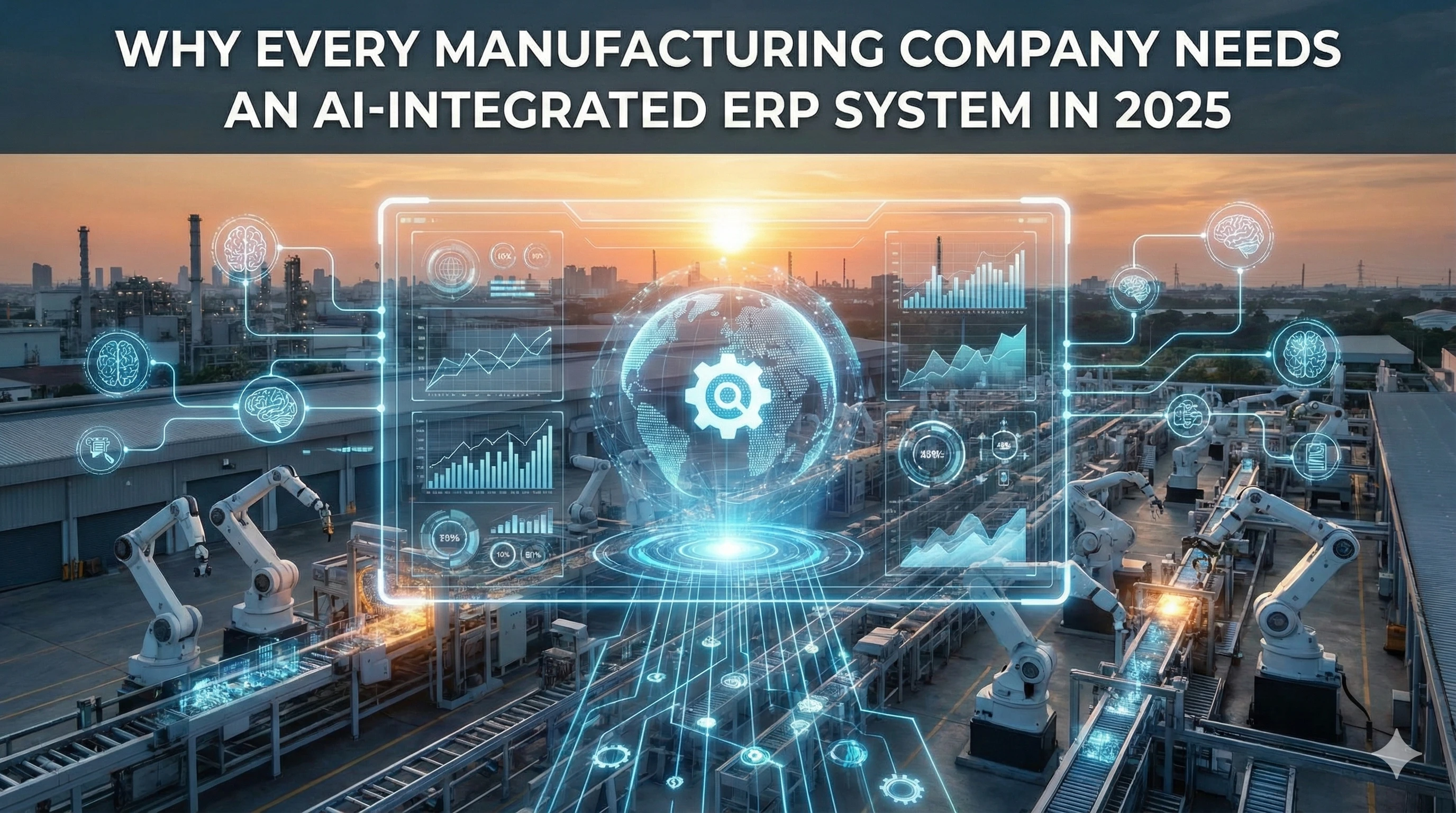
Why Every Manufacturing Company Needs an AI-Integrated ERP System in 2025
In the fast-paced world of manufacturing, efficiency, accuracy, and speed are no longer competitive advantages — they are survival factors. As manufacturers deal with volatile market demand, global supply chain disruptions, and rising operational costs, digital transformation has moved from optional to urgent.
At the center of this transformation is a next-generation solution reshaping the industry: AI-integrated ERP systems.
In this article, we explore why every manufacturing company — from small factory units to multi-plant enterprises — must adopt AI-powered ERP software to stay profitable, agile, and future-ready.
1. Traditional ERP Systems Are No Longer Enough
For decades, ERP systems have streamlined manufacturing operations — from inventory control and production planning to procurement and financials.
But legacy ERP systems were designed for a different era. They are:
-
Reactive, not predictive
-
Static, not adaptive
-
Informational, not intelligent
They collect data — but they don’t learn from it.
AI changes that. When embedded into an ERP, AI delivers:
-
Real-time insights
-
Predictive analytics
-
Autonomous decision-making
-
Smart automation
This turns ERP from a reporting tool into an intelligent command center for the entire manufacturing ecosystem.
2. Smarter Demand Forecasting & Inventory Optimization
Balancing inventory is one of the toughest challenges in manufacturing. Too much stock means blocked capital and high storage costs. Too little stock means lost orders, production delays, and unhappy customers.
An AI-driven ERP analyzes:
-
Historical sales data
-
Seasonal patterns
-
Current market trends
-
Economic indicators
-
Weather patterns
-
Supplier reliability metrics
With this data, it predicts demand with near-perfect accuracy.
Manufacturers can:
-
Reduce excess inventory
-
Prevent stockouts and delays
-
Improve cash flow
-
Minimize waste and overproduction
The result is a lean, efficient, and resilient production model.
3. Real-Time Quality Control & Predictive Maintenance
Machine downtime is one of the biggest hidden losses in manufacturing.
AI-integrated ERP systems use data from IoT sensors to detect early signs of equipment failure. Instead of waiting for a breakdown, the system triggers maintenance alerts — enabling teams to fix issues proactively.
This reduces:
-
Unexpected downtime
-
Repair costs
-
Production losses
Similarly, AI-powered quality control analyzes product data during manufacturing, automatically detecting:
-
Defects
-
Irregularities
-
Pattern deviations
This ensures every batch meets high-quality standards, reducing returns and improving trust.
4. End-to-End Supply Chain Visibility
Today’s supply chains are global, interconnected, and vulnerable. A delay at one node can impact the entire production cycle.
AI-integrated ERP provides complete supply chain visibility, tracking:
-
Raw materials
-
Vendor performance
-
Shipping routes
-
Customs delays
-
Logistics status
Using predictive analytics, it identifies risks (like shortages or transport delays) before they impact operations.
Manufacturers can adjust resources, reschedule production, or switch suppliers instantly, making operations highly resilient.
5. Data-Driven Decision-Making
AI doesn’t just display numbers — it converts them into actionable insights.
It identifies hidden patterns, predicts outcomes, and recommends the best actions across:
-
Production planning
-
Pricing strategy
-
Resource allocation
-
Purchase planning
-
Workforce schedules
Executives get real-time dashboards, automated reporting, and AI-powered recommendations — helping them make accurate, fast, and confident decisions.
No more guesswork — decisions are backed by data.
6. Automation That Boosts Productivity
AI unlocks the true potential of an ERP by automating repetitive and rule-based tasks like:
-
Order processing
-
Invoice validation
-
Production scheduling
-
Material requirement planning
-
Shipment prioritization
This reduces human error, cuts operational time, and frees employees to focus on high-value work:
-
Innovation
-
Process improvement
-
Strategic initiatives
In simple terms: AI turns your ERP into a digital workforce that is active 24/7.
7. Better Customer Experience & On-Time Delivery
Customers today demand speed, transparency, and reliability.
AI-integrated ERP enables:
-
Real-time order tracking
-
Accurate delivery timelines
-
Personalized communication
-
Flexible production scheduling
With predictive analytics, manufacturers ensure raw materials and machines are available exactly when needed — improving on-time delivery rates and customer satisfaction.
This transforms ERP from a back-office tool to a customer-first delivery engine.
8. Competitive Advantage in the Industry 4.0 Era
Manufacturing is entering Industry 4.0 — defined by connected machines, autonomous systems, and AI-driven decision intelligence.
Here, AI-integrated ERP becomes the central brain of a smart factory — connecting:
-
IoT sensors
-
Warehouse robots
-
CNC machines
-
Production lines
-
Smart logistics systems
Early adopters will lead this shift with:
-
Faster innovation cycles
-
Agile production models
-
Lower operational costs
-
Real-time decision-making
Companies that delay adoption risk being outpaced by more intelligent, automated competitors.
Final Thoughts
The question is no longer “Should we adopt AI in ERP?”
It’s “How fast can we do it?”
In a manufacturing world where every second impacts revenue, AI-integrated ERP is not just a technology upgrade — it’s a business strategy.
Manufacturers that embrace it today will:
-
Improve efficiency
-
Increase profitability
-
Build resilient supply chains
-
Deliver better customer experiences
If you’re exploring ERP solutions with AI-enabled capabilities, our experts can help you understand how predictive insights, automation, and real-time intelligence can transform your manufacturing operations.
Popular Tags

Comments 0
Leave a Comment
Your email address will not be published. Required fields are marked *
Category
Recent News
December 08, 2025
Why Every Manufacturing Company Needs an AI-Integrated ERP System in 2025
December 04, 2025
Top Web Development Trends in 2025 | Future of Modern Websites
Popular Tags